My work has taken me across the world’s major oceans. I have ongoing projects in Taiwan, the Indian Ocean, Alaska, and the Atlantic Ocean. My focus is on sharks and deep-sea marine life. I use a variety of methods including molecular genetics, tagging, underwater cameras, and robotics to conduct my research.
Megamouths in Taiwan

The Megamouth Shark is one of the most elusive sharks on the planet. These animals can be up to 30 feet in length; however, they were only recently discovered in 1976– likely because they spend much of their time in the deep-sea and come up to the surface only at night to feed. We know little about them- including their diet, reproduction, and migration patterns. I have spent the past few years working with fishers and local researchers in Taiwan to track and study Megamouth Sharks. In 2018, my research team was the first to data-tag a Megamouth (we eventually tagged three of them). The data we collected has given us invaluable information about their migration and possible diet.
In 2018 I also acquired a large Megamouth specimen (that was being sold at a fish market in Taiwan). I accessioned the fully intact shark into the Smithsonian Museum of Natural History. It is the largest fish specimen in the Smithsonian’s collection to date and I am currently leading a team of researchers on a dissection of the animal. We hope to complete the dissection by late 2024 and publish our findings.
Environmental eDNA and Sharks of the Atlantic Ocean
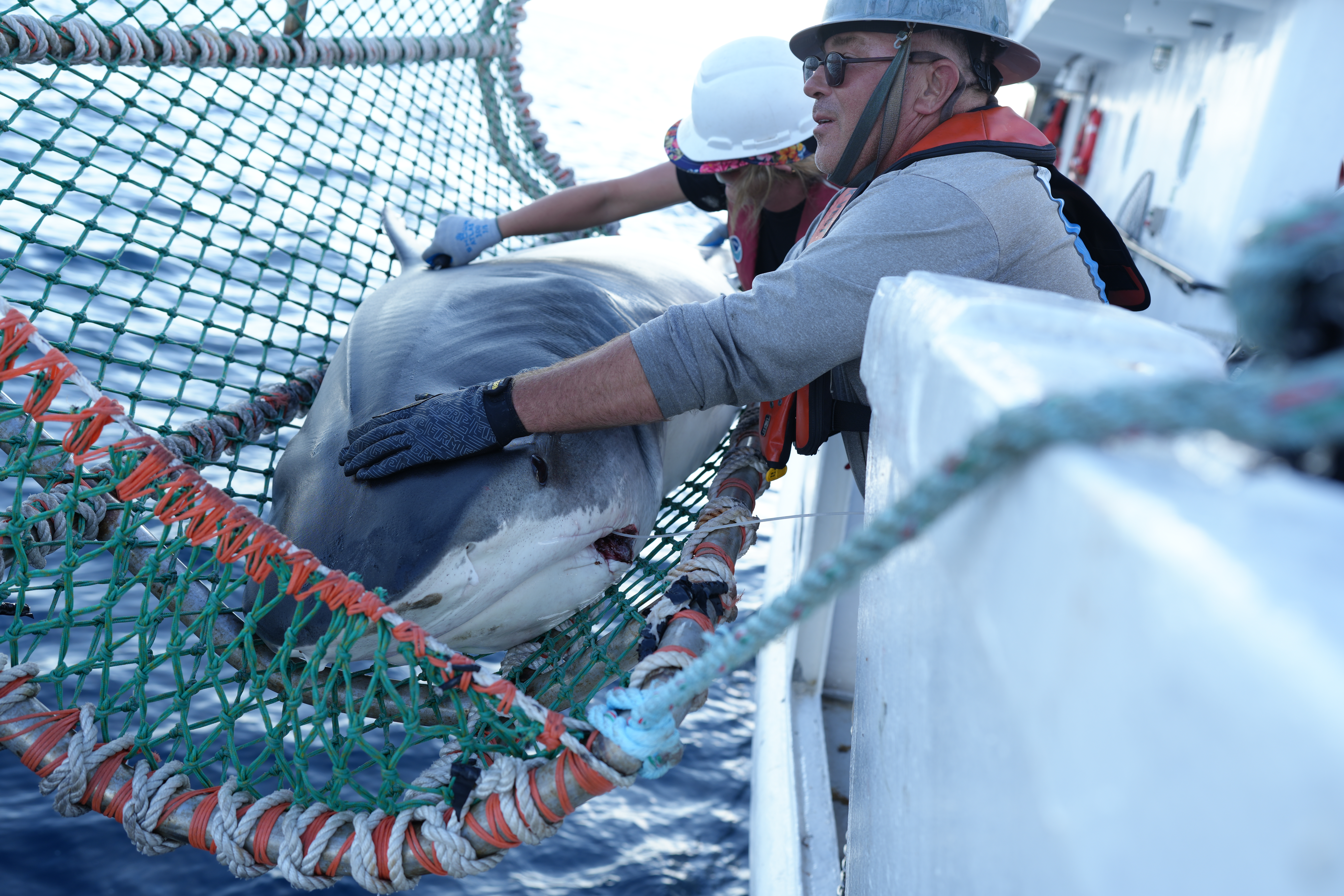
I am currently conducting research on sharks in the Atlantic. I have worked with the Virginia Institute of Marine Science’s Shark Longline (the longest running shark survey in the country) as well as on board the Oregon 2 of the National Oceanic and Atmospheric Administration (NOAA) to tag and study sharks in the Gulf Coast. With this work, I am developing methods of open-ocean environmental DNA sampling to help us gain insight into the populations of sharks that inhabit different regions of the water.
What is environmental DNA and how does it work? When fish and marine animals move through the water, they shed genetic material in the form of dead cells. That genetic material hangs out in the water column and we can capture it by taking a sample of water (literally a bottle of water) and analyzing it. When we look at the genetic material that is present in a water sample, it can tell us important information like what species of fish live in that area and potentially their abundance. This kind of information can then be used to help us track the populations of species in a region and help us to better manage fisheries so that we can conserve threatened marine life.
Deep-sea sharks of the Southern Indian Ocean

I have worked for over a decade in the Southern Indian Ocean alongside fishers to collect valuable data on deep sea sharks in the region. The Southern Indian Ocean (SIO) is virtually unexplored; scientists know very little about the species or abundance of fish in this area. Some researchers estimate that the Indian Ocean may contain one of the largest number of still-undiscovered species.
Although there is little known about the animals and marine habitat in the SIO, there are year-round fishing programs in these waters. Typically we are able to manage fishing practices by knowing about the species that inhabit the area and their relative ability to withstand fishing pressures. However, because we know so little about the species in this region, marine animals are in danger of going extinct before we ever discover them or have the chance to create practical policies. For my research in the SIO, I work with the fishers, policy makers, and scientists to develop better methods of documenting the species in the region. I have discovered over a dozen new-to-science sharks in my research and I have accessioned over 500 specimens into museums across the globe from my expeditions. I have worked with the United Nations as well as the Mauritian Government’s National Plan of Action for Sharks to spearhead these research efforts.
 Paul J. Clerkin